
Linda Vredeveld at El Shed : hunting scenes
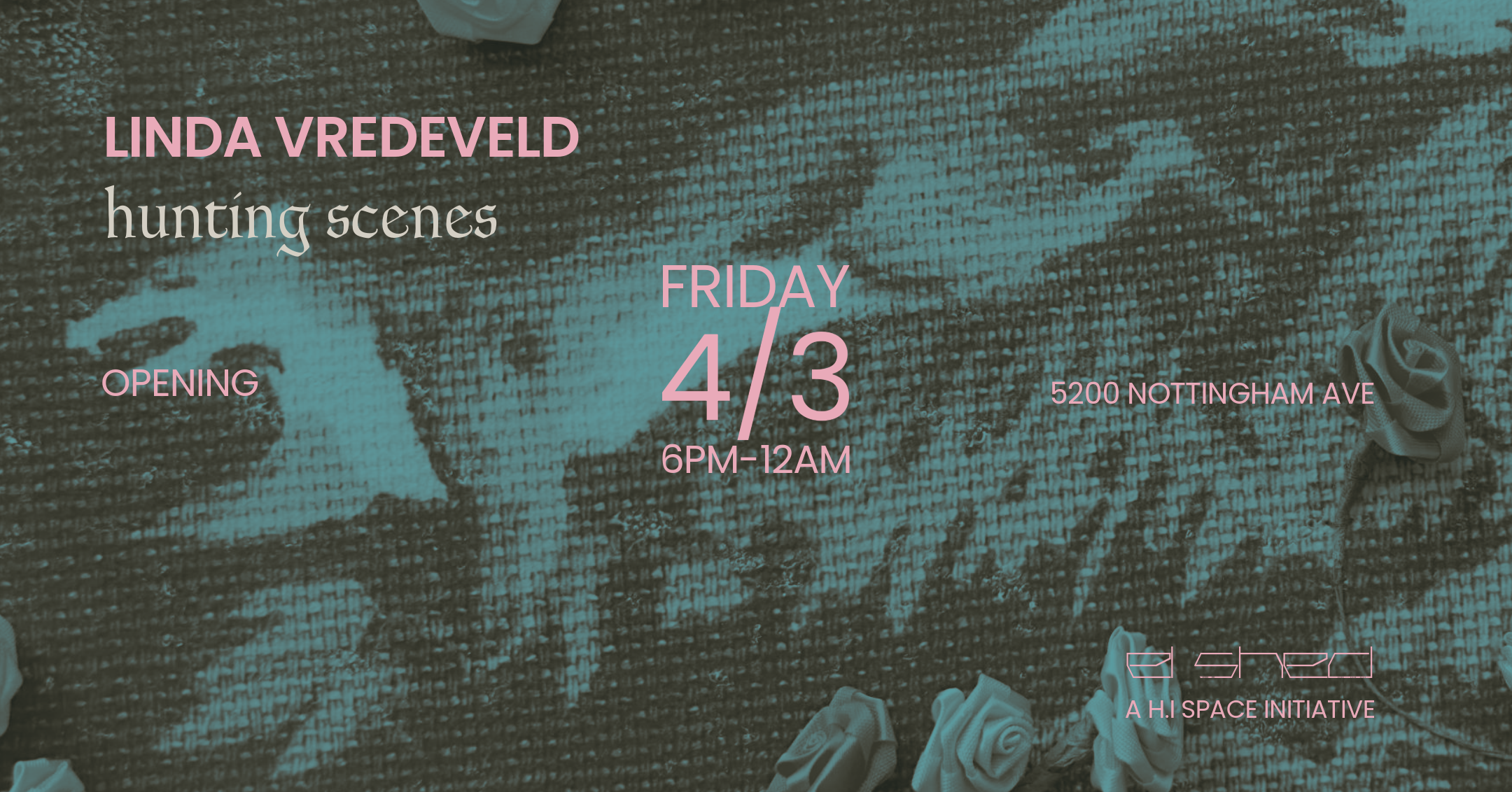
About the work:
Linda Vredeveld's art begins where silence is enforced:in the religious community she grew up in, its domestic rituals, its fixed roles for women, its agreements about what could and could not be said aloud. This exhibition brings together two bodies of work that trace how that inheritance became the subject of her practice. Both are made from the vantage of looking back, with the clarity and irreverence that distance affords.
The earlier pieces grow from a specific story. In 1975, eight-year-old Gretchen Harrington was murdered, a crime silenced for decades by the religious community around her. This is not a distant history for Vredeveld. The man responsible was her mother's first cousin, a pastor. Rather than create a memorial, she turned that proximity into an investigation, weaving collage, figuration, and abstraction around a central question: how do communities decide what is allowed to be known, and who suffers when they choose silence? The work borrows the language of fairy tales and scrapbooks, but its impulse is to untangle, to lay things out in a new way. What looks decorative becomes confrontational.
Gretchen Harrington had a name, a story, a community that chose not to hear it. The more recent series asks a different but related question: what happens to women who were never granted a story at all? Vredeveld works with black-and-white and sepia photographs of unknown women, stock images manufactured as generic filler for mass-produced picture frames from the 1970’s through the 1990’s. Soft, composed, and entirely interchangeable, these women were never meant to be looked at closely. Vredeveld makes that impossible to avoid. She applies expressive brushstrokes in pink, red, and blue directly onto their faces and figures, breaking the monochrome surface with color that feels like interruption, pressure, refusal.
The found materials she brings into these works carry a specific weight. Jewelry, lace, ribbons, brooches shaped like butterflies and animals, doll parts, fabrics printed with hunting and equestrian scenes: all of it sourced from thrift stores, places where things outlive the people who once chose them. These fragments hold the texture of intimate life without any of its identifying details. They also hold instruction. Images of leisure press up against images of the body. The public performance of class sits beside the private fact of a face. Vredeveld doesn't try to fill in the blanks of a life she can't know, but she refuses to look past it either. She arranges what remains until its codes become legible again
Over these surfaces she paints directly, sometimes obscuring a face, sometimes pulling it forward, occasionally marking it with a single word like God. The gesture implicates not just the image but the whole commercial and devotional machinery behind it: the frame manufacturer, the photographer, the congregation, the assumption that a woman's appearance is a surface for others to define.
What this work uncovers isn't a forgotten history so much as a familiar one, made visible again. The small instructions passed down through objects and images and silences accumulate until they become invisible. Vredeveld's sustained attention to the cast-off and the anonymous is, quietly, a refusal to let that stand.
Bio:
Linda Vredeveld is a St. Louis based artist whose work has been exhibited widely across the Midwest and beyond. She holds an MFA in Painting and Drawing from the University of Illinois at Urbana-Champaign and has shown at venues including the Kranzberg Arts Foundation, the Schmidt Art Center, and Gallery 210 at the University of Missouri. Her work was featured in New American Painting, Midwest Issue #167 (2024), and she has been a two-time finalist for the Great Rivers Biennial at the Contemporary Art Museum St. Louis.
About El Shed:
A H.I Space Initiative dedicated to supporting artists developing experimental, situation-based work within a 16x17' space. We provide a focused environment with the essential resources of time and space, supplemented by professional mentorship, critical feedback, high-quality documentation, and promotional support.
We are fiscally sponsored by TechArtista, a 501(c)(3) nonprofit organization. This allows us to receive tax-deductible donations and grants to support our mission.
You can support our work by making a tax-deductible donation here